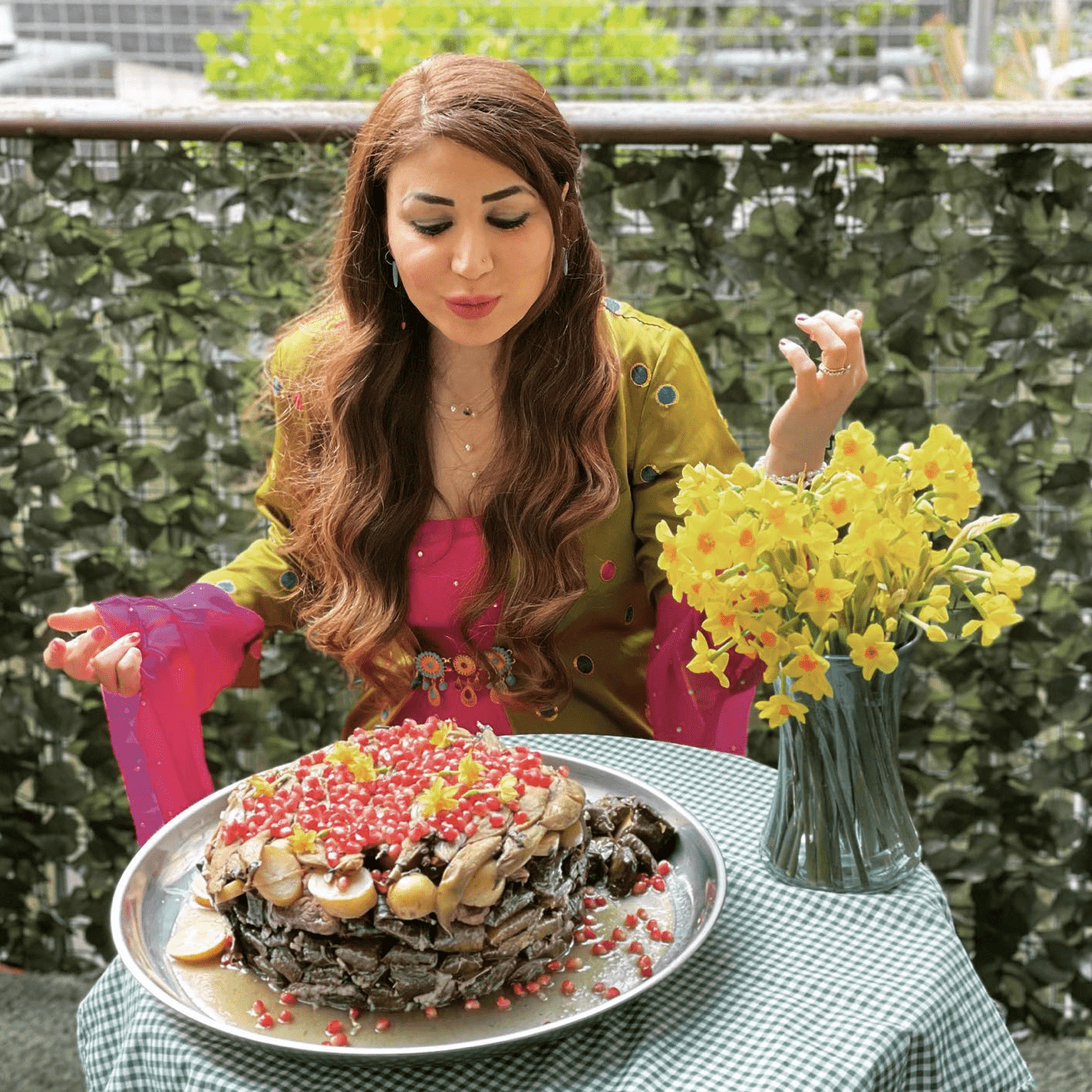
As the holy month of Ramadan arrives in my part of the world, naturally, this blog post is dedicated to food. Not extravagant cuisines and tables set for a King, but classical, simple meals that are homecooked with love to bring a family together at the end of the day.
Kurdish food, for those who are yet to indulge in the taste is rich in its roots of natural flavours, and uses of different plants from nature; today many dishes remain passed down from a grandmother to daughter and granddaughter – which is probably the reason why a dish like Kfta and even Dolma has different flavours depending on which family cook it and from which area of the greater Kurdistan they are from.
During the Covid-19 lockdown – when the world went into complete silence– I recall being in the kitchen every day for a new meal. It was during that time that I came across some of the most talented young Kurdish food artists. Yes, food is an art in my world. An art that I do not seem to master very easily. However, a handful of passionate cooks and kitchen angels have given me the magic wand.
One of the accounts I began following belonged to a Lawyer, Mekhak, who is the person behind Foodie Therapy Official – Mekhak is based in London, working fifty-hour weeks as a CQC, Care Quality Commissioner. I met Mekhak for an interview, only to realise her personality is sweeter than the desserts she shared on her online platforms.
With a very busy lifestyle, Mekhak’s food is centered around health and simplicity. In my meeting with her, she continuously mentioned “simple and quick” meals and it was not hard for me to witness this beautiful young woman’s passion for food. “The reason I am doing what I do is I am trying to show people, everyone can cook: women, men, kids and no matter how busy you are, you can cook.”
For long I have searched for Kurdish recipes online, other than the very few cookbooks, the visual quality in videos and pictures is often poor, videos are very long and even unclear when voice is used. I found myself fast-forwarding and rewinding just to make sure if something was salt, sugar, or baking soda. It becomes stressful. Mekhak’s presentation is colourful, vibrant, lively, bright, impeccable quality and it is exceptionally easy to follow the steps. For an amateur cook, this is a dream.
Her Instagram page is not monetised. She often uses the platform to also raise awareness on food culture, for example she reminds her audience about the importance of recreating leftover meals and talks about food waste.
I ask Mekhak about how she manages to create and share meals in the midst of her hectic professional life. She replies casually, “I film whatever I cook during the weekend, and I do the editing and translation in the commute to and from work.” Time management working at its best. She makes the processes seem so effortless, yet seeing the end quality, it feels much more effort is fed into her online content. She does not have a team of professionals helping her, no fancy cameras or lighting, just her and her iPhone. “I place my iPhone in the gimbal, and I record. I then do the editing on my iPhone too.”
Since following Mekhak I never need to watch a 35-minute YouTube video to learn to cook a meal. She condenses her YouTube videos to a maximum of three minutes. Imagine a place where you can learn to cook a delicious meal in just three minutes. In fact, the average video on her YouTube channel for recent dishes she has posted is 58 seconds. And if this was not enough, she presents the meals in three different languages: Kurdish, Arabic and English for her foreign audiences.
With more than one hundred recipes written and ready for when she decides to create a cookbook, she continues to reach more than 20, 000 people on her online platforms on Instagram and YouTube; the little square photos she posts on her Instagram feed are mouth-watering and her videos make any non-professional feel they can master their next meal.
In the series I have been writing for Ebtedy, I realise all the creatives say the same words – painters, candle makers, content creators and even food creators all have an inner passion and drive. Mekhak is no different, “my happiest moments are when I try new recipes and it works. I am not scared of new recipes, even those I haven’t tried before. It makes me happy when it turns out delicious,” she explains to me.
I ask Mekhak about how she incorporates the heavy Kurdish foods into her content, she laughs knowing very well I refer to the extra oil used in many households. She mentions a point that I had not previously considered “If you think of Kurdish cuisine, it is in fact very healthy, but we make it unhealthy by adding a lot of oils. When you make that lovely stew, it is full of goodness you don’t need to add the extra ghee, brine and oil.”
“I try to educate people that our cuisine is very healthy, just don’t ruin it with the oils. For example, when I make Tapsi (fried vegetables in red sauce stew), I never fry the ingredients, I bake them instead.” She laughs adding that the kitchen will also remain cleaner, and the house does not feel greasy.
We discuss together the feedback of her audience, I realise Mekhak is content when individuals online replicate her recipes, and share photos of their meals with her. We look at traditional Kurdish cuisines as difficult, needing hours of preparation and a lot of effort – what makes Mekhak, and the few like her popular among modern young Kurds is the twist towards simplicity, and time efficiency. The way the recipe is presented, the step-by-step guidance, in a very modern way, is equivalent to watching your loving grandmother cooking in front of you – but in less than a minute!
Mekhak is not the only young Kurd who shares her joy for cooking with an online audience. Shna, also a Kurd and a London-based teacher is behind the page Kurdish Best Food.
Harvard graduate Alka is also renowned for her page A Kurdish Foodie, which is also among my favourites. During the Covid-19 pandemic, I wrote on my blog about Alka, it read: “From my phone’s screen I could smell Yaprakh with all its juiciness, with mixed flavours of sourness and a kick of spice, I could feel the crumbling, melting walnut Kulicha in my drooling mouth and had the instant urge to kneed dough… the @Akurdishfoodie page became my happy place while in quarantine. I felt in love with the cook behind the screen but had never met her or known her real name. I wrote her recipes in my prettiest notebook and labelled each recipe with A Kurdish Foodie Yaprax, a Kurdish Foodie Kulicha, A Kurdish Foodie Kifta and you get the point.”
For people like me, who have a lifestyle that differs to our grandmothers, these sources of food creators online have made home cooking of our traditional meals a lot easier than what we originally think. Homemade, made with love, and a home smelling of freshly cooked food gives warmth and a touch of love that no takeaway meal will substitute – we will speak all about the outburst of the takeaway culture in our next blog post!
Ramadan Mubarak from the Kurdistan of Iraq.
By: Sazan M. Mandalawi, a facilitator, a PhD candidate in the field of education, and a passionate blogger herself focusing on culture and the creative scene in the Kurdistan Region of Iraq.
Copyright photos: Foodie Therapy Official